
Table of Contents
Drawing is about volume—not just lines. When you sketch everything as overlapping boxes and spheres, you unlock a deeper understanding of form, structure, and spatial relationships. This foundational approach transforms flat sketches into dimensional studies, giving your drawings weight, clarity, and realism. Whether you’re sketching a figure, a landscape, or a still life, thinking in terms of volume helps you build complex compositions from simple shapes.

credit: xbiostrois
Why Volume Is the Foundation of Drawing
Volume is what separates a flat doodle from a convincing sketch. It’s the illusion of three-dimensionality that makes your drawings feel alive and grounded.
- Form Over Outline: Instead of tracing contours, you build the object from the inside out.
- Spatial Awareness: Understanding volume helps you place objects accurately in space.
- Dynamic Composition: Overlapping shapes create depth and interaction between elements.
Boxes and Spheres: The Core Building Blocks
Boxes for Structure
Boxes represent rigid, angular forms—perfect for architecture, furniture, and mechanical objects. They help define perspective and orientation.
- Use Cases: Buildings, books, tables, limbs, torsos
- Benefits: Easy to rotate in space, define edges and planes
Spheres for Organic Forms
Spheres are ideal for soft, rounded shapes. They’re the basis for heads, joints, fruits, and many natural elements.
- Use Cases: Faces, muscles, animals, clouds
- Benefits: Smooth transitions, flexible placement, easy to shade
Combining Shapes



Most objects are hybrids. A human figure, for example, can be broken down into boxes (torso, pelvis) and spheres (head, shoulders, knees). Sketching this way simplifies complex subjects.
Sketching with Overlapping Forms
The Power of Overlap
Overlapping boxes and spheres create visual hierarchy. They show which parts are in front, behind, or intersecting.
- Depth Cue: Overlap is a key indicator of spatial depth.
- Interaction: Helps objects relate to each other in space.
- Flow: Guides the viewer’s eye through the composition.
Gesture and Volume
Start with a loose gesture drawing, then layer boxes and spheres to define volume. This keeps your sketches dynamic and avoids stiffness.
- Gesture First: Capture movement and flow.
- Volume Second: Anchor the gesture with form.
Light and Shadow
Boxes and spheres respond predictably to light. Use this to your advantage when shading.
- Boxes: Planar shading—each face gets a different tone.
- Spheres: Gradient shading—smooth transition from light to dark.


Practical Exercises to Build Volume Skills
Exercise 1: Box Rotation
Draw a cube from multiple angles. Practice rotating it in space to understand perspective.
Exercise 2: Sphere Placement
Sketch spheres overlapping each other. Shade them to show which is in front.
Exercise 3: Hybrid Forms
Break down a complex object (like a chair or animal) into boxes and spheres. Sketch it from different angles.
Exercise 4: Figure Construction
Use boxes for torso and pelvis, spheres for joints and head. Build a figure from gesture to volume.
Common Mistakes and How to Fix Them
Flat Drawing
Problem: Outlines without volume.
Fix: Start with 3D shapes, not contours.
Misaligned Perspective
Problem: Boxes don’t match vanishing points.
Fix: Use horizon lines and guides to align shapes.
Overcomplication
Problem: Too many shapes, cluttered sketch.
Fix: Simplify—use fewer, larger forms to start.
Ignoring Gesture
Problem: Stiff, lifeless drawings.
Fix: Begin with loose gesture lines before adding volume.
 Sketchbooks.org | SITE NEWS
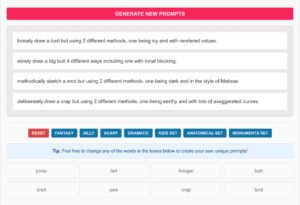
The Sketch Prompt Generator
Explore an endless stream of ideas. Discover our prompt generator designed to give you a fresh creative starting point whenever you need it.
Frequently Asked Questions
Why should I sketch with boxes and spheres?
They simplify complex forms and help you build accurate, dimensional drawings.
Can I use this method for figure drawing?
Yes, it’s ideal for constructing human anatomy with clarity and proportion.
How do I know when to use a box or a sphere?
Use boxes for angular structures and spheres for rounded, organic shapes.
Is overlapping necessary in every sketch?
Not always, but it adds depth and helps define spatial relationships.
What’s the best way to practice volume drawing?
Start with simple objects and rotate them in space using basic shapes.
How does this help with shading?
Boxes and spheres respond predictably to light, making shading easier and more realistic.
Can I combine boxes and spheres in one object?
Absolutely—most real-world forms are combinations of both.
Do I need to draw perfect shapes?
No, rough shapes are fine for construction; refinement comes later.
How does gesture relate to volume?
Gesture captures movement; volume gives it structure and weight.
Should I erase the construction lines?
Only if needed—sometimes they add energy and clarity to the sketch.
Final Thoughts
Drawing is about volume. When you sketch everything as overlapping boxes and spheres, you move beyond surface-level representation into the realm of form, space, and structure. This approach builds confidence, improves accuracy, and opens the door to more dynamic and expressive art. Whether you’re sketching a still life or designing a character, thinking in terms of volume will elevate your work and deepen your understanding of visual storytelling.

credit: jasonpogo
Ready to Share Your Work?
Do you include text or notes in your sketchbooks?